How to trim your dog's nails
You want to keep your dog’s nails short without hitting the quick, the sensitive part inside the nail, and know what to do if a nail bleeds.
By Grooming Dogs · Updated October 5, 2026
- How often to trim: see how often to trim nails.
- If your dog panics or pulls away: start with if your dog won’t let you.
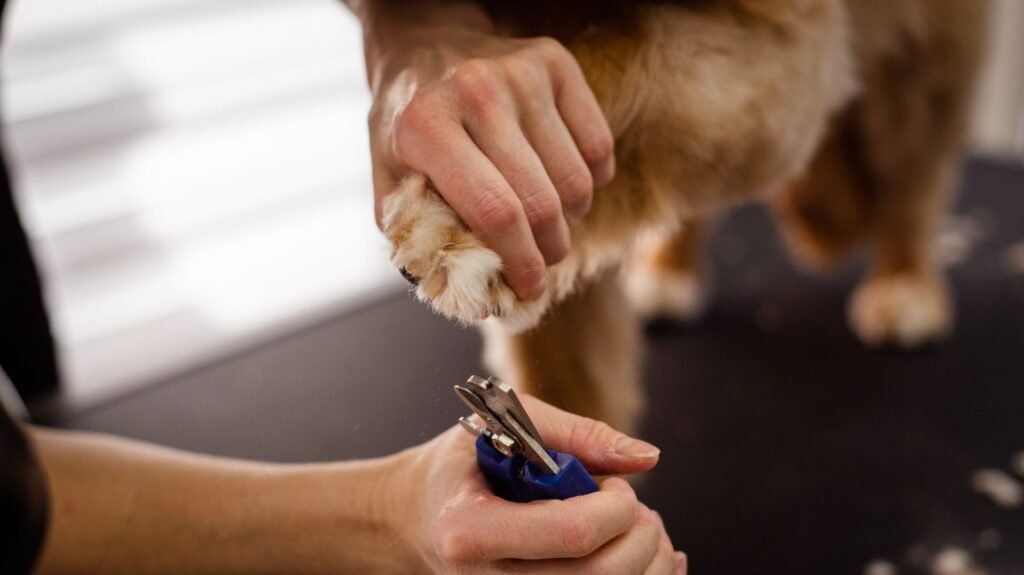
Short answer:
- Hold the toe gently so the nail extends.
- Clip only the tip, straight across, taking small amounts [1].
- Stop before the quick. On light nails it’s the pink area. On dark nails, stop when the cut end shows a chalky ring or a shiny, moist-looking center [1][3].
- If you nick the quick, press styptic powder or cornstarch onto the tip [4]. If the bleeding hasn’t stopped after a few minutes, call your vet [4].
- For very long nails, trim a little at a time rather than all at once [1][3].
Why nail length matters
Nails that grow too long can cause problems:
- Movement: long nails can affect how your dog walks and places their feet [2][3].
- Discomfort and breakage: they can cause discomfort and make broken nails more likely [2].
- Snagging: a long nail can catch on something like carpet and break, which is painful and can bleed [3].
- Feet and legs over time: over a long period, overgrown nails can change the shape of the foot and strain the leg [1].
Signs a trim is due:
How often that happens depends on your dog. See how often to trim nails.
Finding the quick
The quick is the living core of the nail. It carries blood vessels and nerves, so cutting into it hurts and makes the nail bleed [1][5].
Light-colored nails
On white or clear nails, you can see the quick as a pink area inside the nail [1][2]. Clip the nail tip well short of the pink.
Black nails
You can’t see the quick through a dark nail [2][3]. Instead, take off a little at a time and look at the cut end after each trim [6][3]:
If you’ve never trimmed nails before, ask your vet or a vet tech to show you how [1].
Trimming step by step
Choosing a clipper or grinder? See choosing clippers or a grinder.
- Get comfortable. Your dog can sit or lie beside you, on your lap or on a non-slip surface, wherever they’re settled [3].
- Hold the paw gently but firmly. Put your thumb on the pad of a toe and your forefinger on the skin above the nail [1].
- Move any fur out of the way so you can see the whole nail [1].
- Extend the nail: push your thumb slightly up and back on the pad while pushing your forefinger forward [1].
- Clip only the tip, straight across [1]. Don’t clip past the point where the nail curves down [1].
- Check the cut end before taking any more, especially on dark nails. See Finding the quick above.
- Give a treat, then move to the next nail. You don’t have to do every nail in one go.
Dewclaws
If your dog has dewclaws, the nails higher up on the inner side of the paw, include them when you trim [1]. Use the same method: hold the toe, extend the nail, and clip only the tip.
Stop and see your vet if a nail is cracked, split, torn or broken, or the toe is swollen, red, has discharge, or your dog is licking it or limping. Don’t try to trim around an injury.
If your dog is older and finds standing or holding a paw up difficult, see nail care for older dogs.
Grinder or clipper?
Both are safe when used correctly. Some dogs tolerate a grinder better, while others prefer clippers [1].
| Clippers | Grinder | |
|---|---|---|
| How it works | Cuts the tip off in one squeeze | Wears the nail down a little at a time [5] |
| Things to know | Guillotine-style clippers have a single blade. Some veterinary guidance advises against them because they can crush the nail rather than cut it cleanly [3]. Scissor- or plier-style clippers, where two blades cross, avoid this [3]. | Makes noise, which some dogs find frightening [5]. Grinding too long in one spot can heat the nail and make your dog uncomfortable, so use short touches [3]. |
| Often suits | Quick, routine trims | Thicker nails, or dogs that dislike the feel of clippers [5] |
Using a grinder safely [1]:
- Use a grinder made for dogs.
- Grind only a small part of the nail at a time.
- Support the toe firmly but gently.
- Grind across the bottom of the nail, then carefully in from the tip, smoothing rough edges.
- Hold the grinder higher up, toward the top, for better control.
- If your dog has long hair, hold it back so it can’t get caught in the grinder.
Keep clippers handy even if you usually grind. You may need them for an area the grinder can’t reach [3].
For which specific tool to buy, see choosing clippers or a grinder.
If you cut the quick
Nicking the quick happens, even to careful owners. Your dog will probably yelp and may pull away [4].
- Stay calm, and keep hold of the paw if you can do so safely.
- Apply styptic powder or cornstarch to the bleeding nail tip straight away. Press gently so it sticks [4][1].
- Give it a few minutes. A cut quick may bleed for a few minutes. It can be briefly painful [3].
- Leave the rest of the nails for another day if your dog is upset.
Call your vet if the bleeding hasn’t stopped after a few minutes [4], or if the nail looks damaged.
Shortening overgrown nails
If the nails have been left to grow, you can’t cut them back to a short length in one session.
Why: the quick grows along with the nail. Regular trimming helps it recede from the end [1]. Once a nail and its quick have grown long, though, there’s a limit to how much can be trimmed back at once [3].
What to do:
- Trim little and often: take off just the tip each time, stopping before the quick, and repeat on a regular schedule (see how often to trim nails). Over time the quick shortens with the nail [1].
- Don’t try to fix it in one go. Cutting deep enough to reach the quick will hurt your dog and make them wary of the next trim.
- Get help if the nails are very overgrown, curling, or you can’t see where to stop. Your vet or a groomer can help.
Common questions
Does walking on pavement file a dog's nails down?
It can help. Some dogs wear their nails down and won’t need trimming as often [1]. Many still need regular trims, though, so keep checking for clicking and length rather than relying on walks alone.
Can I use human nail clippers on my dog?
It’s best to use clippers or a grinder made for dogs [1]. They’re designed for the shape and thickness of a dog’s nail. See choosing clippers or a grinder.
Where to go next
How often your dog’s nails need trimming.
Grooming a dog who hates being groomed
If nail trims are a battle, start here.
Choosing clippers or a grinder.
Nail care for older dogs.
This is general information about grooming healthy dogs, not veterinary advice. If a nail is broken or torn, a toe is swollen, or bleeding won’t stop, contact your vet. How we write, source and fund our guides.
Sources
- [1] Harriet Meyers, American Kennel Club: “How to Trim Your Dog’s Nails Safely”, published September 29, 2022, updated June 1, 2026. https://www.akc.org/expert-advice/health/how-to-trim-dogs-nails-safely/
- [2] AKC Staff, American Kennel Club: “How to Groom Your Dog at Home: Easy Tips for Everyday Care”, updated September 2, 2026. https://www.akc.org/expert-advice/health/how-to-groom-a-dog/
- [3] VCA Animal Hospitals (content by LifeLearn Animal Health): “Handling Exercises for Trimming Nails and Brushing Teeth”, © 2023. https://vcahospitals.com/know-your-pet/handling-exercises-for-trimming-nails-and-brushing-teeth
- [4] ASPCA: “At-Home Pet Grooming: Top Tips and Recommendations”, April 9, 2020. https://www.aspca.org/news/home-pet-grooming-top-tips-and-recommendations
- [5] Toronto Humane Society: “Trimming your Dog’s Nails” (PDF, June 2021). https://www.torontohumanesociety.com/wp-content/uploads/2021/10/Trimming-Your-Dogs-Nails.pdf
- [6] Humane World for Animals: “How to groom your dog at home” (undated). https://www.humaneworld.org/en/resources/how-groom-your-dog-home