Choosing a dog groomer and knowing what to expect
You’re thinking about a professional groomer, or you’ve booked one, and you want to know how to pick a good one, what will happen on the day, and what to do if it goes wrong.
By Grooming Dogs · Updated October 5, 2026
We don’t recommend or list individual groomers. This page covers what to look for.
Short answer:
- Visit before you book. Look for a clean, well-ventilated space, and watch how dogs are handled [1][2].
- Ask questions, including about training and experience, how dogs are kept and dried, health and vaccination policies, and what happens in an emergency [1][2].
- Tell the groomer about your dog, including their health, sore spots and how they cope with handling, and describe the cut you want rather than relying on a cut name.
- If your dog is hurt, get them checked by your vet first, then raise it with the groomer [4][5].
What happens at a grooming appointment
Services vary, so ask what’s included. Most grooming businesses offer bathing, drying, brushing, clipping, ear cleaning and nail trimming [2]. A typical visit looks something like this:
- Drop-off and a short chat. The groomer looks at your dog’s coat and asks what you want done. This is the time to mention health issues, sore spots and anything your dog finds difficult.
- Brushing out. Tangles and mats are dealt with first. If the coat is badly matted, the groomer may suggest clipping it short (see the FAQ below).
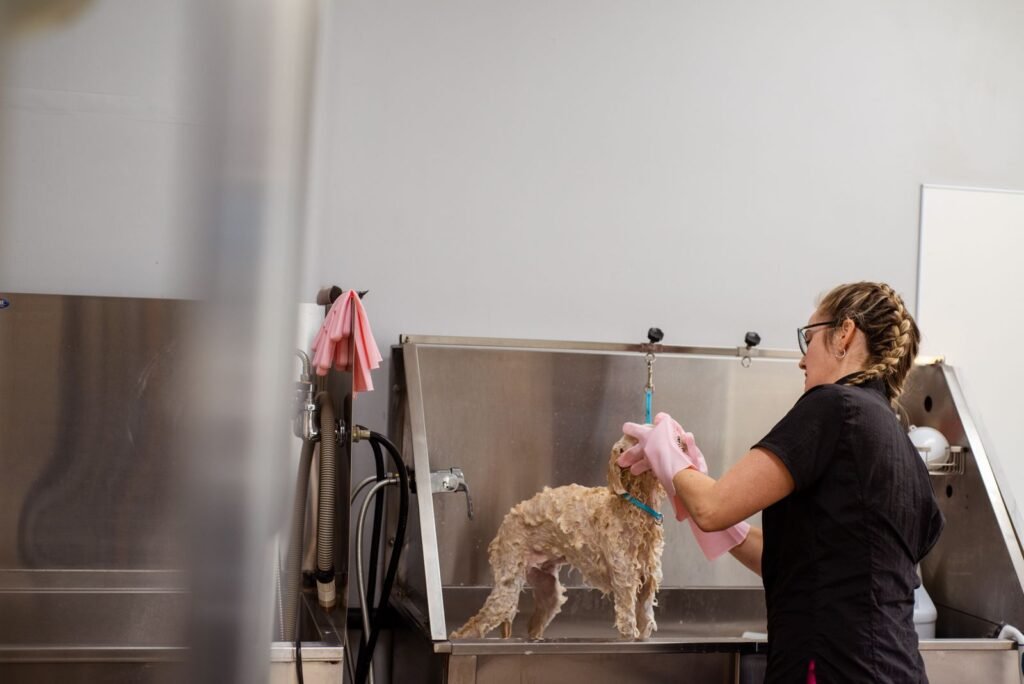
- Bath and drying.
- Haircut or trim, if you’ve asked for one.
- Nails and ears, if they’re part of the service.
- Waiting and pick-up. Ask how your dog will be kept while they wait. Dogs not on the grooming table should be in a clean crate or a secure area, with fresh air, where staff can see them [1].
How long it takes depends on your dog’s size, coat and condition, and on what’s being done. Some dogs simply take longer than others [1]. Ask for an estimate when you book, and for a call when your dog is ready.
Some things only a vet should do. Proper dental cleaning needs anesthesia so a vet can clean below the gum line, and only a vet should empty anal glands [2]. For brushing your dog’s teeth at home, see brushing teeth.
How often to book: see how often to book. What it costs: what grooming costs.
Salon, mobile, self-wash or home visit?
| Option | What it is | Can suit | Things to check |
|---|---|---|---|
| Salon | You take your dog to a grooming business | Many dogs; the widest range of services | How dogs are housed and dried while waiting [1][2]; how long your dog will be there |
| Mobile groomer | A groomer works from a van or trailer parked at your home [2] | Dogs who find travel or busy places hard; owners short on time | The same standards as a salon: cleanliness, handling, drying, an emergency plan [1] |
| Home visit | A groomer comes into your home | Similar to mobile; often simpler services | What they can do without a full grooming setup |
| Self-wash | You wash your dog yourself using a business’s tubs and equipment | Dogs who mostly need a bath; owners who’d rather do it themselves | Non-slip footing and a dog-safe dryer setting. See bathing your dog. |
There’s no single best option. Think about how your dog copes with travel, other dogs and being away from you, and what work their coat actually needs. If your dog is fearful, see groomers for anxious dogs.
How to choose a groomer
Start with recommendations from people you trust, such as friends, your vet, trainers or boarding kennels [1][2]. Then talk to the groomer in person. How they answer, and how they discuss your concerns, tells you a lot [1].
In the US, whether a groomer needs a license or permit depends on the state, and sometimes the city or county [5]. Some states license grooming businesses. Connecticut, for example, requires a state license to run a grooming business [8]. Other places have no grooming-specific license [2][5]. If it matters to you, ask whether one is required where you live, and whether the groomer holds it. A certificate from a course or a voluntary program isn’t the same thing as a legal license. Training also varies: some groomers learn on the job, and others attend a grooming school [1]. Taking part in voluntary continuing education is a good sign [1].
Questions to ask
- Can I see where you work? [1][2]
- What’s your training and experience, and do you have experience with my dog’s breed or coat type? [1]
- What services are included, and what isn’t? [1][2]
- How will my dog be kept when they’re not being groomed? [1]
- How do you dry dogs? If heated dryers are used, how do you make sure dogs don’t overheat or get burned? [2][3]
- Do you need proof of vaccination, and do you accept dogs who seem unwell? [2]
- Do you have a first aid kit, and is someone trained in first aid always there? [1]
- Do you carry liability insurance? [1]
- What happens in an emergency, and how would you contact me? [1]
- Can I stay and watch, at least the first time? [1]
What to look for on a visit
- The space: it should be clean and well ventilated, with sturdy tables and tubs [1][2].
- Handling: watch how the dogs are handled. They should be handled gently, and you shouldn’t see dogs who look very stressed [2].
- Waiting areas: look for clean, comfortable crates or a secure space, in view of staff [1][2].
- A first aid kit in plain view [1].
Ask yourself: would I be comfortable leaving my dog here? [1]
Preparing for the first appointment
- Practice at home. Brushing your dog and handling their paws at home helps them feel more comfortable at the groomer [2]. For a puppy, see a puppy’s first groom.
- Have your dog’s vaccination records ready if the groomer asks for them [2].
- Tell the groomer about any health conditions, lumps, sore or stiff spots, recent skin or ear problems, and how your dog reacts to handling, nail trims, dryers or other dogs.
- For an older dog: ask about shorter sessions and breaks. See grooming an older dog.
- For a nervous dog: say so when you book. See groomers for anxious dogs.
- Agree what’s being done before you leave, and ask what will happen if the groomer finds mats or anything unexpected.
- Leave a phone number where you can be reached during the appointment.
Asking for the cut you want
Cut names like “puppy cut” or “teddy bear cut” mean different things to different groomers. The clearest approach is to describe what you want. See cut styles:
- Length: how long you want the hair on the body, legs and head;
- Face, ears and tail: what to do with each;
- A photo: bring one of a cut you like.
Before they start, check what the groomer understands by any cut name, and ask whether your dog’s coat suits it. If your dog’s coat is matted, the cut you asked for may not be possible (see the FAQ). For terms you might hear, see grooming terms.
Warning signs
- No visit: the groomer won’t let you see where your dog will be groomed or kept [1][2].
- Dirty or stuffy: the space is dirty, smells bad or is poorly ventilated [1][2].
- Rough handling: dogs are handled roughly, or several look very stressed [2].
- No health policy: there’s no vaccination policy, or the groomer accepts dogs who seem unwell [2].
- Unsupervised heated dryers: dogs are left in cages with heated dryers without anyone watching. Heated cage dryers have been linked to serious injuries and deaths [3], so ask how the staff prevent overheating [2].
- Sedation offered: the groomer offers to sedate your dog. A dog who needs sedating should be groomed at a veterinary practice, where they can be monitored [2]. See groomers for anxious dogs.
- Vet-only services: the groomer offers services that should be done by a vet, such as dental cleaning or emptying anal glands [2].
- Vague answers: the groomer can’t tell you what they’d do in an emergency [1].
If something goes wrong
If your dog comes home hurt, sore or unwell:
- Contact your vet first. Cuts, sores, burns or other injuries need to be checked [4].
- If your dog is bleeding heavily, struggling to breathe or has collapsed, get urgent veterinary help.
- If you’ve noticed itching, redness, bumps or head shaking, see problems after grooming for what to look for.
Then:
- Keep a record: photos of the injury, your vet’s notes and bills, receipts, any messages with the groomer, and the date and time [5][9].
- Talk to the groomer first, calmly. Ask what happened, and whether they carry insurance that covers injuries [1][5][9].
- If that doesn’t resolve it, where to turn depends on your state and the kind of problem:
- A dispute with the business: your state or local consumer protection office can help with complaints against businesses [9][10]. You can also notify your local Better Business Bureau, a consumer organization rather than a government office, which tries to resolve complaints against companies [9].
- A licensing concern: where groomers need a license or permit, the agency that issues it may also take complaints [5].
- Money or damages: legal advice, or the legal system, may be an option [5][9]. This page isn’t legal advice, and no route guarantees a particular outcome.
- If you believe an animal was harmed deliberately, contact the police or your local animal control [5].
If you’re unhappy with the cut, tell the groomer soon and specifically. Many problems can be fixed or avoided next time with a clearer brief (see “Asking for the cut you want” above).
If your dog is now frightened of grooming, see groomers for anxious dogs. If the change is sudden and they also seem sore, see your vet.
Common questions
Should I tip my dog groomer?
Tipping is your choice, not a requirement, and there’s no official rule about how much. If you’re not sure what’s usual at a particular business, ask them. Repeat bookings and a good review are also appreciated.
Can I stay with my dog while they're groomed?
It’s reasonable to ask, especially the first time. Watching can show you how your dog copes, which is useful for future visits. But some dogs are more anxious when their owner is nearby, because they pick up on their owner’s nerves [1]. Policies vary between groomers, so ask when you book.
Why was my dog shaved when I asked for a trim?
Usually because the coat was matted:
- Why it hurts: mats pull at the skin, and wet mats tighten as they dry [6].
- The kinder option: brushing out heavy matting can be painful for the dog, and clipping the coat short may be kinder [7]. The coat will grow back.
- Avoiding a surprise: agree in advance what the groomer should do if they find mats, so you aren’t caught out. To prevent mats between visits, see brushing and mats.
Where to go next
Grooming a dog who hates being groomed
Finding a groomer for a nervous dog.
How often should you groom your dog?
How often to book.
Describing the cut you want.
Something wrong after a groom?
This page is general information, not legal or veterinary advice. Rules for groomers and complaint routes vary by location. How we write, source and fund our guides.
Sources
- [1] Jan Reisen, American Kennel Club: “What to Ask Potential Groomers Before You Hand Them Your Dog”, published April 27, 2021, updated March 27, 2026. https://www.akc.org/expert-advice/health/questions-ask-potential-groomers/
- [2] The Vetstreet Team, Vetstreet: “Selecting a Groomer”, July 12, 2011. https://www.vetstreet.com/care/selecting-a-groomer
- [3] New York City Bar Association, Committee on Legal Issues Pertaining to Animals: Report on Legislation A.7502-B / S.5702-A (prohibiting heated cage or box dryers at grooming facilities), c. 2012. https://www.nycbar.org/wp-content/uploads/2023/05/20072263-BanningHeatedGrooming.pdf
- [4] AKC Staff, American Kennel Club: “How to Groom Your Dog at Home: Easy Tips for Everyday Care”, updated September 2, 2026. https://www.akc.org/expert-advice/health/how-to-groom-a-dog/
- [5] Elinor Molbegott, North Shore Animal League America: “Groomers injured my dog.” (Pet Legal Q&A), January 6, 2023. https://www.animalleague.org/blog/advice/pet-legal-advice/groomers-injured-my-dog/
- [6] Ann Hohenhaus, DVM, The Animal Medical Center: “Can Bath Time be Dangerous for Pets?”, November 30, 2016. https://www.amcny.org/blog/2016/11/30/can-bath-time-dangerous-pets/
- [7] Terry Albert, Fear Free Happy Homes: “12 Tips To Caring For Your Senior Dog’s Coat”, February 6, 2018. https://www.fearfreehappyhomes.com/12-tips-to-caring-for-your-senior-dogs-coat/
- [8] Connecticut General Assembly: Connecticut General Statutes, Chapter 435, Sec. 22-344(c) (accessed October 5, 2026). https://www.cga.ct.gov/current/pub/chap_435.htm
- [9] USAGov: “How to file a complaint about a company’s products or services”, last updated July 2, 2026. https://www.usa.gov/company-product-service-complaints
- [10] USAGov: “State consumer protection offices” (accessed October 5, 2026). https://www.usa.gov/state-consumer