How to groom your dog at home, from start to finish
You’ve decided to groom your dog yourself. This page gives you the whole routine in the order that works best, what to have ready, and the point where the job stops being a home job.
By Grooming Dogs · Updated October 5, 2026
This page covers the full routine at overview level. Each step links to a detailed guide. How often to repeat each step depends on your dog’s coat. See the grooming schedule by coat type.
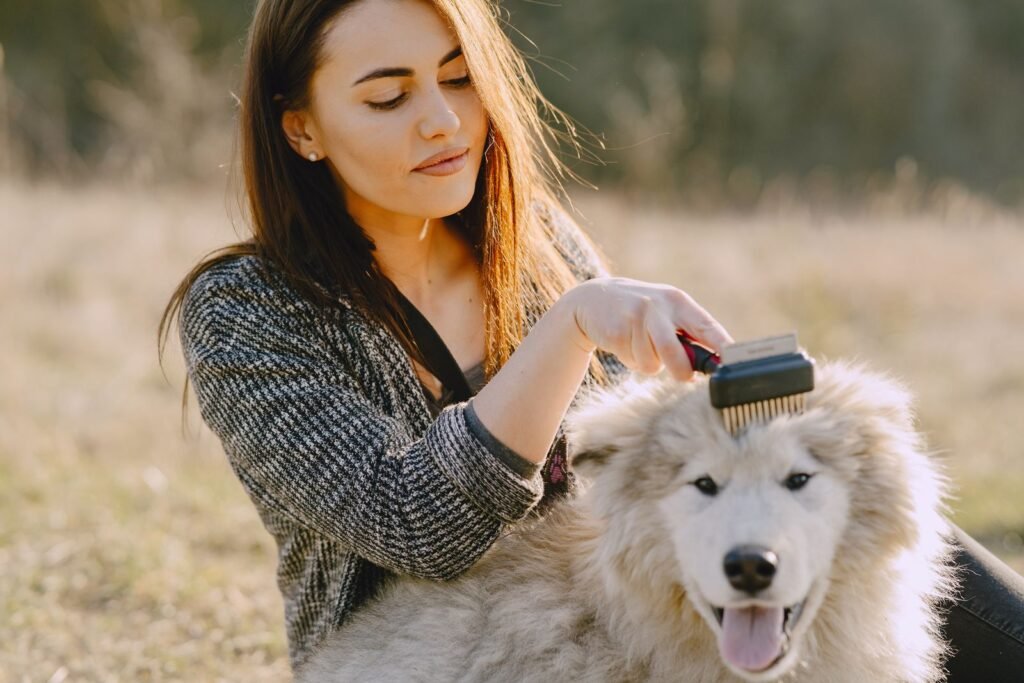
Short answer:
- Brush the dry coat out completely.
- Trim the nails.
- Check and wipe the ears.
- Bathe with a dog shampoo and dry thoroughly.
- Clean the face and teeth.
- Trim only what needs it.
Brushing comes first because mats tighten once they get wet. Stop and hand over to a groomer or vet if you find tight mats, sores, or anything your dog finds painful.
Before you start
A home groom goes best when your dog is calm and you aren’t rushing.
- Pick a calm moment. After a walk, when your dog is relaxed, is easier than when they’re full of energy.
- Choose the space. A quiet room with a non-slip surface works well. A bath or shower with a non-slip mat suits the washing stage.
- Know your dog’s coat. The routine is the same for every dog, but how you brush and what you trim depend on the coat. If you’re not sure what your dog has, identify your dog’s coat type first.
- Keep treats within reach. Short pauses for a reward help your dog stay settled through each step.
What you’ll need
- A brush suited to your dog’s coat, and a comb
- Nail clippers or a nail grinder, plus styptic powder or cornstarch in case a nail bleeds
- Dog shampoo
- Towels, and a hair dryer with a cool setting if you use one
- Dog ear cleaner and cotton balls or pads
- A soft cloth or damp cotton balls for around the eyes
- A dog toothbrush and dog toothpaste
- Blunt-tipped scissors, only if you plan to trim
- Treats
Not sure which brush or clippers to get? See choosing the right grooming tools.
Why the order matters
The order isn’t arbitrary. Each step sets up the next one.
- Brush before the bath. Water doesn’t loosen mats. It tightens them as they dry, and dense mats hold moisture against the skin [1]. A coat that’s brushed out first washes and dries properly.
- Do nails and ears while your dog is dry and calm. These are the fiddly jobs. They’re easier before a bath, while your dog is still settled.
- Dry completely before you trim. A clean, dry, brushed coat shows you what actually needs trimming. Damp hair hides uneven patches.
- Face, eyes and teeth come near the end. They’re quick, and your dog is used to being handled by then.
The routine, step by step
You don’t have to do everything in one session. Splitting the routine across a few days is fine, especially while your dog is getting used to it.
1. Brush the whole coat while it's dry
Brush all the way down to the skin, section by section, rather than skimming the top of the coat. Feel for knots behind the ears, under the legs and around the collar.
The full technique, including line brushing and dealing with small knots, is in how to brush your dog properly.
2. Trim the nails
Take off small amounts at a time and avoid the quick, the living part inside the nail. Keep styptic powder or cornstarch nearby. If a nail bleeds, press a little onto the tip [2]. If the bleeding doesn’t stop, call your vet.
Step-by-step instructions, including black nails, are in how to trim your dog’s nails.
3. Check and wipe the ears
Look inside each ear flap. Using a dog ear cleaner on a cotton ball or pad, gently wipe away dirt and wax from the parts you can see. Lift it away rather than rubbing it in [2]. Don’t push anything down into the ear.
If an ear is red, smells unusual, has discharge, or your dog pulls away in pain, stop and see a vet rather than cleaning it.
The safe method is in how to clean your dog’s ears safely.
4. Bathe and dry
- Use a dog shampoo. Human hair products aren’t designed for dogs [1].
- Keep shampoo away from the eyes. It can irritate them, and can cause a painful injury to the surface of the eye [1].
- Rinse until the water runs clear.
- Dry thoroughly. Towel-dry first. If you use a hair dryer, keep it on a cool setting, because a hot dryer can burn a dog’s skin [1].
Setup, shampoo choice and drying are covered in full in how to bathe your dog.
5. Clean the face, eyes and teeth
Face and eyes. Gently wipe around the eyes with a damp cotton ball or soft cloth [2]. Healthy eyes look clear and bright [2]. If you notice redness, cloudiness, swelling, squinting or discharge that doesn’t clear, contact your vet.
Teeth. Brush with a toothbrush and toothpaste made for dogs. Never use human toothpaste. The reasons, and how to get your dog used to it, are in how to brush your dog’s teeth.
6. Trim only what needs it
At home, keep trimming to the small jobs:
- the hair between the paw pads;
- the area under the tail;
- hair that falls into the eyes.
Use blunt-tipped scissors or clippers, on a clean, dry, brushed coat. Full haircuts and styling are best left to a groomer.
What’s realistic at home, and how to do it safely, is in trimming and haircuts at home.
Mistakes that cost the most
- Bathing before brushing. Mats get tighter, not looser [1].
- Cutting out mats with scissors. It’s easy to cut skin hidden under the mat [1].
- Using your own shampoo. Human hair products aren’t made for dogs [1].
- Drying on a hot setting. Use towels, then a cool dryer setting [1].
- Pushing through when your dog is struggling. A stressed dog is harder and riskier to groom, and the next session gets harder too. If your dog resists, stop and see grooming a dog who hates being groomed.
- Carrying on through pain. If your dog yelps or flinches at one spot, stop. Pain is a reason to see a vet, not to hold the dog still.
When it stops being a home job
Plenty of grooming can be done safely at home. Some situations need someone else.
Book a groomer if:
- the coat has tight mats close to the skin;
- you want a full haircut or a breed-style trim;
- your dog can’t be groomed safely at home yet.
See choosing a groomer.
Get help with resistance if your dog panics, struggles or snaps during grooming. See grooming a dog who is anxious or resistant.
See a vet if, while grooming, you find:
- sores, scabs, redness or broken skin;
- lumps or swellings you haven’t noticed before;
- signs of parasites;
- an ear that is red, smelly or painful;
- eye problems that don’t clear;
- a nail that won’t stop bleeding;
- anything that makes your dog cry out.
Ask your vet about skin problems or persistent scratching rather than treating them yourself [2].
If something looks wrong after a groom, start with problems after grooming.
Common questions
How long does grooming a dog at home take?
It depends on your dog’s coat, size and how used they are to being handled. A short, smooth coat is quick. A long or curly coat takes much longer, especially the brushing. Nothing has to be done in one go. Spreading the steps over a few sessions is fine.
Do I need a grooming table?
No. A non-slip surface at a comfortable height is enough, and many owners groom on the floor. If you do lift your dog onto a raised surface, stay with them and keep a hand on them the whole time.
Can I do the whole routine in one session?
You can, but you don’t have to. Many dogs cope better with shorter sessions, such as brushing and nails one day and the bath another. Keep brushing before bathing whichever way you split it. For how often to repeat each step, see the grooming schedule by coat type.
Where to go next
Turn this routine into a schedule for your dog’s coat.
How to brush your dog properly
Brushing is the step everything else depends on.
Get the few tools your dog’s coat actually needs.
For the jobs that aren’t home jobs.
This is general information about grooming healthy dogs, not veterinary advice. If your dog is unwell, in pain or has a skin, ear, eye or mouth problem, contact your vet. How we write, source and fund our guides.
Sources
- [1] Ann Hohenhaus, DVM, The Animal Medical Center (New York): “Can Bath Time be Dangerous for Pets?”, 30 November 2016. https://www.amcny.org/blog/2016/11/30/can-bath-time-dangerous-pets/
- [2] ASPCA: “At-Home Pet Grooming: Top Tips and Recommendations”, 9 April 2020. https://www.aspca.org/news/home-pet-grooming-top-tips-and-recommendations